McMurdo SmartFind G8 PLUS AIS EPIRB Manual
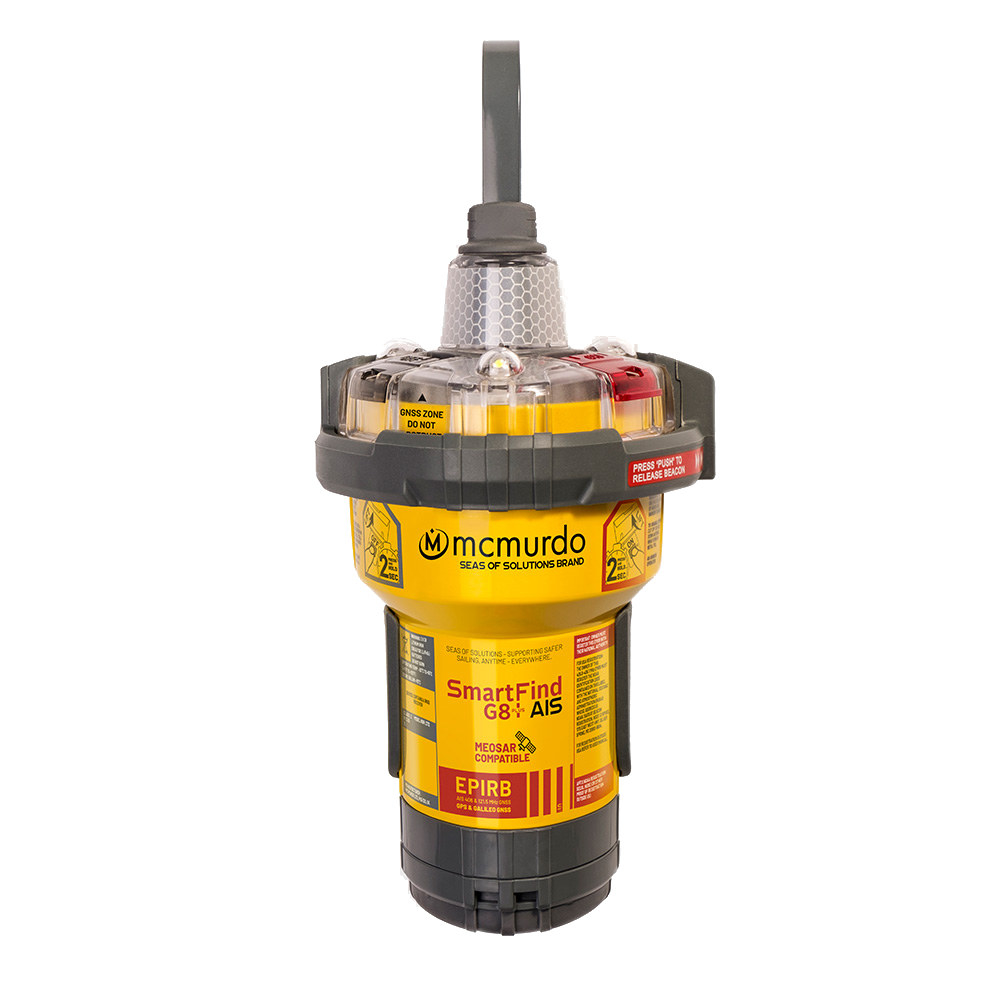
RRP:€834.90
You save: €55.90 (7%)
Price: €779.00
€643.80 ex. VAT
Choose option
MCMURDO 23-002-001A
Preorder
3 days (approx.)
+ −

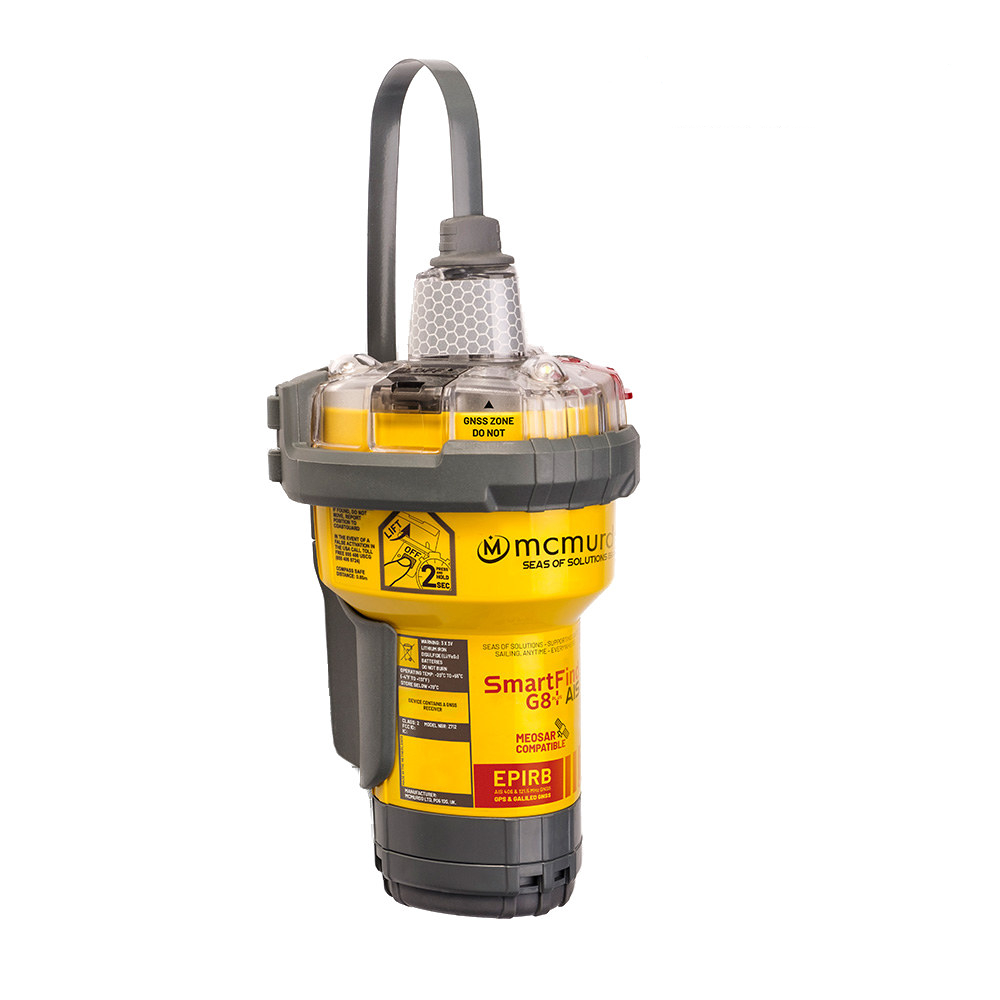
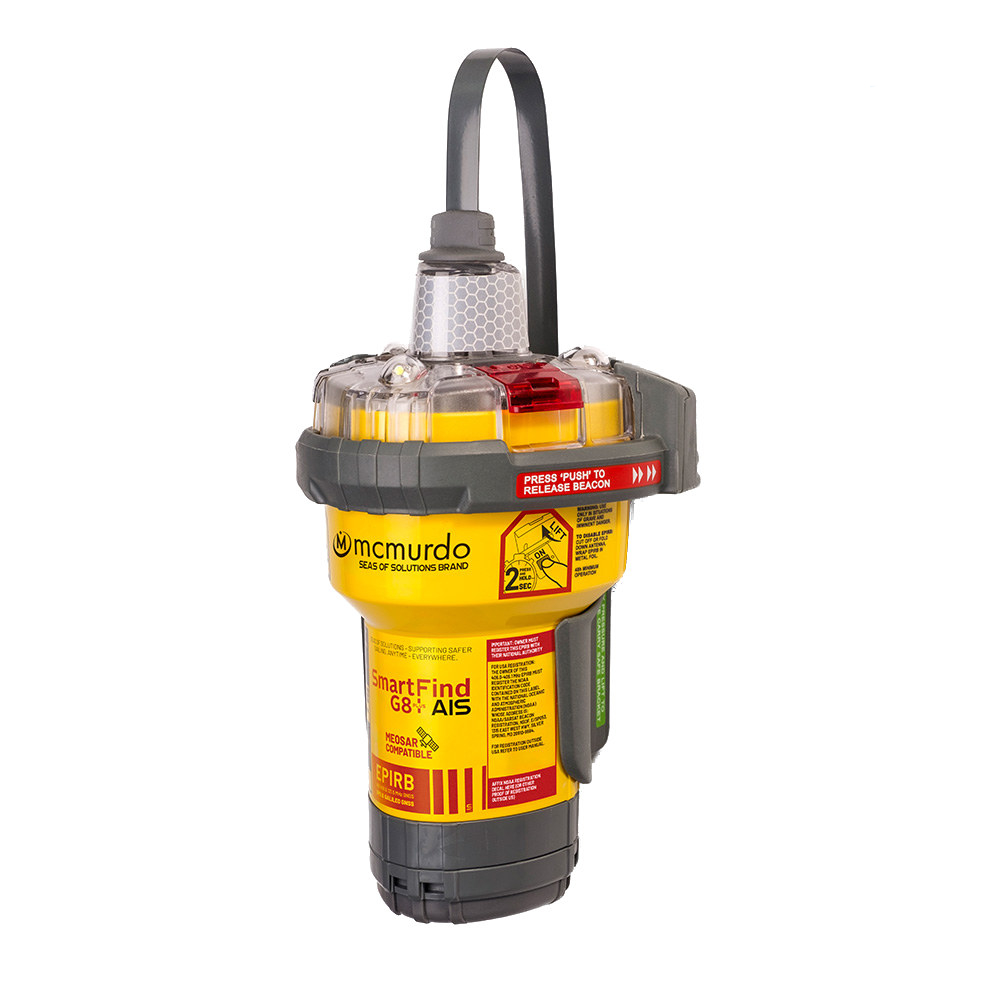
The McMurdo SmartFind G8 PLUS AIS is a marine emergency position-indicating radio beacon (EPIRB). It transmits a 406 MHz distress alert through the Cospas-Sarsat system, a 121.5 MHz homing signal and a local AIS locating message, and it has a GNSS receiver for GPS and Galileo.

The same beacon is offered in two versions:

  • Manual model (part number 23-002-001A) is a Category II EPIRB supplied with a SmartTransfer manual bracket
  • Auto model (part number 23-002-501A) is a Category I EPIRB supplied in a float-free auto-housing with a hydrostatic release unit (HRU)
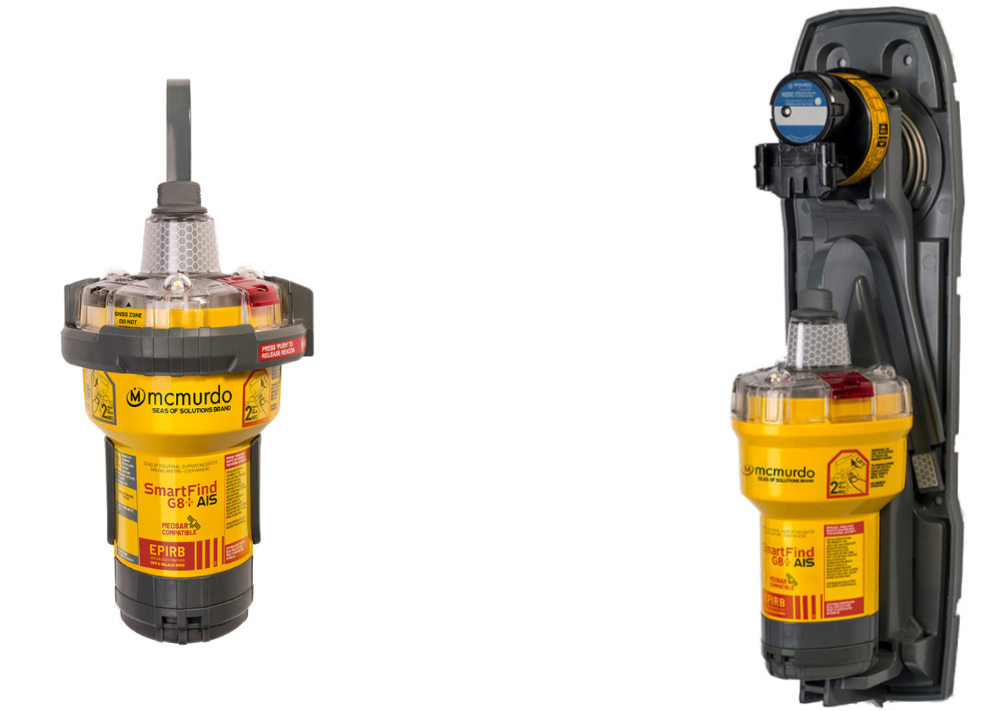
McMurdo G8 AIS EPIRB

How it works

When the EPIRB is activated, it broadcasts on several frequencies at once: the 406 MHz Cospas-Sarsat alert, the 121.5 MHz homing tone, and the AIS locating message around 162 MHz. Visible and infra-red strobes start immediately. 

406 MHz Cospas-Sarsat alert - The 406.040 MHz transmitter has a nominal power of 5 W. The beacon is type-approved for the Cospas-Sarsat system (TAC 398) and is  MEOSAR compatible, so the alert can be detected by the current medium-earth-orbit search and rescue satellites as well as by the older constellation.

121.5 MHz homing and optical signal - A 121.5 MHz swept-tone transmitter (70 mW nominal) is provided for final radio homing. The optical homer uses three high-intensity LED strobes and three high-intensity infra-red night-vision LEDs. Light output is at least 0.75 cd / 2.5 mW/sr, at 23 flashes per minute.

GPS and Galileo position - The GNSS receiver works with both GPS and Galileo, 92 channels, with a ceramic patch antenna and a minimum sensitivity of −167 dBm. The current position is included in the distress messages when the receiver has a fix.

AIS locator - A built-in AIS transmitter sends a distress-related locating message on AIS 1 (161.975 MHz) and AIS 2 (162.025 MHz) at 1 W EIRP. The message includes the unit identity and GNSS position, is repeated eight times per minute, and is typically received by vessels with a VHF AIS antenna out to a range of about four miles.

Manual or Auto installation - Category II (Manual) is supplied with the SmartTransfer bracket, which holds a magnet that deactivates the sea contacts so the beacon can be carried without water-activating. Once it is removed from every part of the bracket, it can be activated by hand or by water. Category I (Auto) is supplied in a spring-loaded float-free housing that deploys and activates the EPIRB when it is submerged between 1 and 4 m, and the beacon can also be activated manually.

Features

  • Manual or water activation, with a reusable SmartSwitch cover over the ON button to help prevent accidental activation.
  • SmartCarry concealed hands-free carry strap and SmartBase impact protection on the beacon.
  • Self-tests: the official datasheet allows 120 short tests and 20 long tests, which include a check of the GNSS receivers, over the ten-year battery life (a monthly short test and two long tests a year are recommended).
  • Lithium iron disulphide battery with a minimum operating life of 48 hours and a shelf life of 10 years from the date of manufacture.
  • Operating temperature −20 °C to +55 °C (Class 2); storage temperature −30 °C to +70 °C.
  • The float-free auto-housing uses the same fixing points as earlier McMurdo auto-housings, so a previous housing can be replaced with limited change to the mounting.

Dimensions
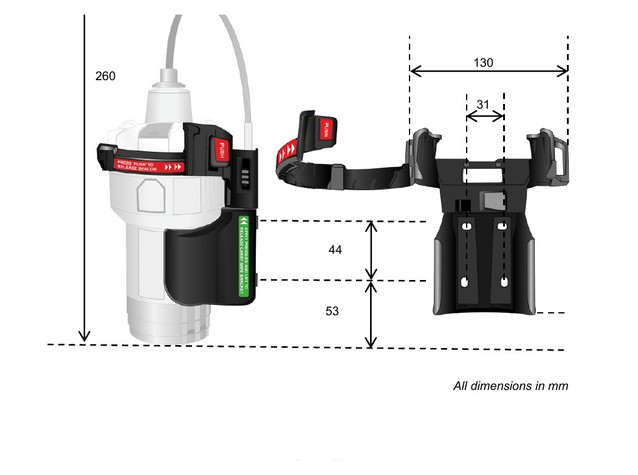
Official McMurdo metric dimension drawing of the EPIRB in the SmartTransfer manual bracket, in mm

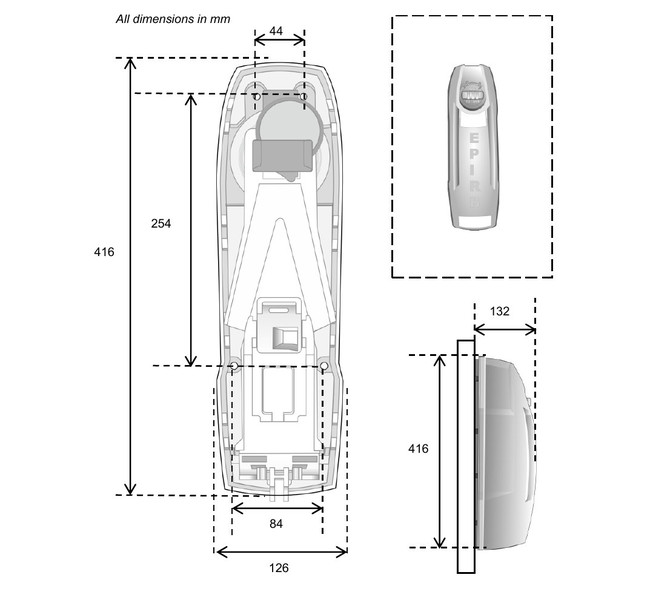
Official McMurdo metric dimension drawing of the float-free auto-housing, in mm

All dimensions in mm. Drawings: McMurdo / Seas of Solutions.

Fitting

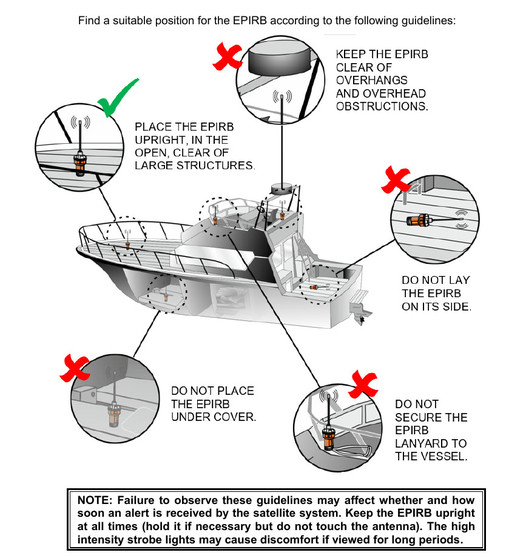
Official McMurdo guide: site the EPIRB upright in the open, clear of overhangs and cover

The official manual asks you to site the Manual bracket on a bulkhead, in plain view near an emergency exit, where it can be reached quickly, and at least 1 m from any compass. The bracket is supplied with four stainless steel screws and mounts through four slots; the fixing holes are drilled at 3 mm. A self-adhesive instruction plate should be mounted next to the EPIRB.

The Auto float-free enclosure should stand upright on a vertical bulkhead, or lie horizontally on a flat, free-draining surface such as a cabin or wheelhouse roof. No other orientation is recommended. It is supplied with a set of stainless-steel fixings (a 4 mm hex key is required; washers should be fitted under the bolt heads). Leave the obstruction-free area shown on the official drawing. The HRU expiry date must be marked on the outside of the enclosure.

Once the beacon is out of its bracket or housing, keep it upright in the open. Do not lay it on its side, place it under cover or under an overhang, or secure the lanyard to the vessel: the official placement guide warns that this can delay or prevent a satellite alert. The EPIRB is designed to be used floating in the sea.

Maintenance

The official servicing schedule calls for a short self-test every month and for the HRU, if fitted, to be replaced at the interval marked on the unit and on the enclosure (typically every 2 years). The McMurdo HRU Replacement Kit is part number 23-145A. A dealer safety check is listed at 5 years, and a dealer battery replacement at 10 years, or earlier if the beacon has been activated or if the battery expiry date has been reached. Shore-based maintenance on mandated vessels must follow the flag administration and must not exceed 5 years.

FAQ

What is the difference between the Manual and Auto models? - They use the same SmartFind G8 PLUS AIS beacon. Manual (23-002-001A) is Category II and comes with the SmartTransfer manual bracket. Auto (23-002-501A) is Category I and comes in a float-free auto-housing with an HRU, which releases the beacon if the vessel sinks and the housing is submerged between 1 and 4 m.

Does this EPIRB include Galileo Return Link Service (RLS)? - No, RLS is available only on the separate SmartFind G8 PLUS RLS models (23-002-000A and 23-002-500A).

Must the EPIRB be registered? - Yes, you must register the EPIRB with the appropriate authorities, usually the national authority of the country code already programmed into the beacon (or through the International Beacon Registration Database where that country uses it). The programmed country is shown on the rear identity label. An EPIRB is also a radio transmitter and must be added to the vessel’s radio licence.

Is programming included? - Yes. Programming with the vessel and country coding is included and is carried out by the distributor before dispatch.

How often should the battery and the HRU be replaced? - The battery has a 10-year shelf life from the date of manufacture and must also be replaced after the beacon has been activated, or before the expiry date on the pack. The HRU, on the Auto model, is typically replaced every 2 years (see the date marked on the HRU and the enclosure) with kit 23-145A. McMurdo also recommends a 5-year health check at an approved service agent.

Which approvals does it hold? - Cospas-Sarsat Type Approval Certificate 398 (C/S T.001 and C/S T.007). For Europe it is listed as MED equipment, with official Module B certificate DK-MED000175 Issue 02 (TÜV SÜD DANMARK) under MED/5.6, and matching Module D and declaration of conformity documents. UK MER / UKCM certificates are published on the official product page. The MED file references SOLAS Chapter IV carriage and performance requirements, including IMO Resolution MSC.471(101). 

Specifications

Beacon McMurdo SmartFind G8 PLUS AIS EPIRB
406 MHz transmitter 406.040 MHz, 5 W nominal, phase / BPSK (16K0G1D)
121.5 MHz transmitter 121.5 MHz, 70 mW nominal, AM swept tone (3K20A3X)
AIS transmitter 161.975 MHz (AIS 1) and 162.025 MHz (AIS 2), 1 W EIRP, GMSK/FM (16K0GXW)
GNSS receiver GPS (L1) and Galileo (E1), 92 channels, 1,575.42 MHz, −167 dBm minimum (official datasheet). The official user manual and Cospas-Sarsat TAC 398 also list GLONASS at 1,602.00 MHz.
Optical homer 3 high-intensity LED strobes and 3 infra-red night-vision LEDs; at least 0.75 cd / 2.5 mW/sr; 23 flashes per minute
Battery type Lithium iron disulphide (Energizer L91 cells in the type-approval file)
Operating life 48 hours minimum
Battery shelf life 10 years from the date of manufacture
Operating temperature −20 °C to +55 °C (Class 2)
Storage temperature −30 °C to +70 °C
Automatic release depth 4 m maximum (Auto housing, submerged 1–4 m)
EPIRB size (incl. antenna) 425 × 105 × 105 mm; antenna 225 mm
EPIRB weight 710 g
Manual bracket 135 × 125 × 125 mm; 110 g
Float-free enclosure 415 × 135 × 135 mm; 1,075 g
Approvals Cospas-Sarsat TAC 398 (C/S T.001, C/S T.007); Europe/UK MED / MER (UKCM); IEC 61097-2 ED4, IEC 60945, IEC 61108-1, RTCM 11000.5, ITU-R M.1371-5, ISED RSS-287, AS/NZS 4280.1; IMO MSC.471(101), A.662(16), A.694(17), A.814(19). USCG and FCC are still marked pending on the official December 2025 datasheet.

Models and part numbers

Version Part number Category Supplied with
Manual 23-002-001A Category II SmartTransfer manual bracket
Auto 23-002-501A Category I Float-free auto-housing with HRU

Included

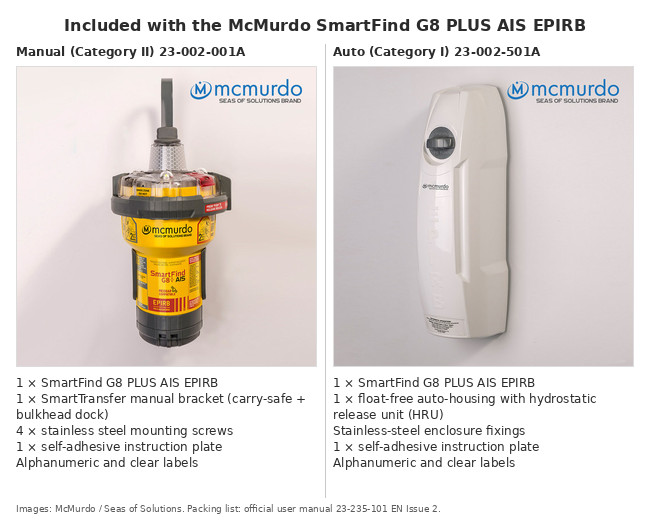
What is included with the Manual and Auto McMurdo SmartFind G8 PLUS AIS EPIRB variants

Manual model (23-002-001A):

  • 1 × SmartFind G8 PLUS AIS EPIRB
  • 1 × SmartTransfer manual bracket (carry-safe bracket and bulkhead dock)
  • 4 × stainless steel mounting screws
  • 1 × self-adhesive instruction plate
  • Alphanumeric stickers and clear protective labels

Auto model (23-002-501A):

  • 1 × SmartFind G8 PLUS AIS EPIRB
  • 1 × float-free auto-housing with hydrostatic release unit (HRU)
  • Stainless-steel enclosure fixings
  • 1 × self-adhesive instruction plate
  • Alphanumeric stickers and clear protective labels

Programming with the vessel and country coding is included. It is carried out by the distributor before dispatch. A change of flag state, or a transfer in most countries other than those listed in the official manual, still requires re-programming by a McMurdo approved service agent.

  Code McMurdo G8 Availability Price
MCMURDO 23-002-001A
Manual (23-002-001A)
3 days
€779.00  (€643.80 ex. VAT)

SmartFind G8 PLUS AIS datasheet, McM 12.25 Iss 2 (EN) (1,745 Kb) - Download

User manual 23-235-101 EN Issue 2 (EN) (3,766 Kb) - Download

Cospas-Sarsat Type Approval Certificate 398 (214 Kb) - Download

MED Module B certificate DK-MED000175 Issue 02 (436 Kb) - Download

MED Module D certificate (415 Kb) - Download

MER Module B certificate (UK) (487 Kb) - Download

MER Module D certificate (UK) (391 Kb) - Download

EU Declaration of Conformity MED/MER V4 (437 Kb) - Download

Product Safety Information 23-Z712 Issue 06 (2,653 Kb) - Download

No posts found

Write a review

The McMurdo SmartFind G8 PLUS AIS is a marine emergency position-indicating radio beacon (EPIRB). It transmits a 406 MHz distress alert through the Cospas-Sarsat system, a 121.5 MHz homing signal and a local AIS locating message, and it has a GNSS receiver for GPS and Galileo.

The same beacon is offered in two versions:

  • Manual model (part number 23-002-001A) is a Category II EPIRB supplied with a SmartTransfer manual bracket
  • Auto model (part number 23-002-501A) is a Category I EPIRB supplied in a float-free auto-housing with a hydrostatic release unit (HRU)

McMurdo G8 AIS EPIRB

How it works

When the EPIRB is activated, it broadcasts on several frequencies at once: the 406 MHz Cospas-Sarsat alert, the 121.5 MHz homing tone, and the AIS locating message around 162 MHz. Visible and infra-red strobes start immediately. 

406 MHz Cospas-Sarsat alert - The 406.040 MHz transmitter has a nominal power of 5 W. The beacon is type-approved for the Cospas-Sarsat system (TAC 398) and is  MEOSAR compatible, so the alert can be detected by the current medium-earth-orbit search and rescue satellites as well as by the older constellation.

121.5 MHz homing and optical signal - A 121.5 MHz swept-tone transmitter (70 mW nominal) is provided for final radio homing. The optical homer uses three high-intensity LED strobes and three high-intensity infra-red night-vision LEDs. Light output is at least 0.75 cd / 2.5 mW/sr, at 23 flashes per minute.

GPS and Galileo position - The GNSS receiver works with both GPS and Galileo, 92 channels, with a ceramic patch antenna and a minimum sensitivity of −167 dBm. The current position is included in the distress messages when the receiver has a fix.

AIS locator - A built-in AIS transmitter sends a distress-related locating message on AIS 1 (161.975 MHz) and AIS 2 (162.025 MHz) at 1 W EIRP. The message includes the unit identity and GNSS position, is repeated eight times per minute, and is typically received by vessels with a VHF AIS antenna out to a range of about four miles.

Manual or Auto installation - Category II (Manual) is supplied with the SmartTransfer bracket, which holds a magnet that deactivates the sea contacts so the beacon can be carried without water-activating. Once it is removed from every part of the bracket, it can be activated by hand or by water. Category I (Auto) is supplied in a spring-loaded float-free housing that deploys and activates the EPIRB when it is submerged between 1 and 4 m, and the beacon can also be activated manually.

Features

  • Manual or water activation, with a reusable SmartSwitch cover over the ON button to help prevent accidental activation.
  • SmartCarry concealed hands-free carry strap and SmartBase impact protection on the beacon.
  • Self-tests: the official datasheet allows 120 short tests and 20 long tests, which include a check of the GNSS receivers, over the ten-year battery life (a monthly short test and two long tests a year are recommended).
  • Lithium iron disulphide battery with a minimum operating life of 48 hours and a shelf life of 10 years from the date of manufacture.
  • Operating temperature −20 °C to +55 °C (Class 2); storage temperature −30 °C to +70 °C.
  • The float-free auto-housing uses the same fixing points as earlier McMurdo auto-housings, so a previous housing can be replaced with limited change to the mounting.

Dimensions
Official McMurdo metric dimension drawing of the EPIRB in the SmartTransfer manual bracket, in mm

Official McMurdo metric dimension drawing of the float-free auto-housing, in mm

All dimensions in mm. Drawings: McMurdo / Seas of Solutions.

Fitting
Official McMurdo guide: site the EPIRB upright in the open, clear of overhangs and cover

The official manual asks you to site the Manual bracket on a bulkhead, in plain view near an emergency exit, where it can be reached quickly, and at least 1 m from any compass. The bracket is supplied with four stainless steel screws and mounts through four slots; the fixing holes are drilled at 3 mm. A self-adhesive instruction plate should be mounted next to the EPIRB.

The Auto float-free enclosure should stand upright on a vertical bulkhead, or lie horizontally on a flat, free-draining surface such as a cabin or wheelhouse roof. No other orientation is recommended. It is supplied with a set of stainless-steel fixings (a 4 mm hex key is required; washers should be fitted under the bolt heads). Leave the obstruction-free area shown on the official drawing. The HRU expiry date must be marked on the outside of the enclosure.

Once the beacon is out of its bracket or housing, keep it upright in the open. Do not lay it on its side, place it under cover or under an overhang, or secure the lanyard to the vessel: the official placement guide warns that this can delay or prevent a satellite alert. The EPIRB is designed to be used floating in the sea.

Maintenance

The official servicing schedule calls for a short self-test every month and for the HRU, if fitted, to be replaced at the interval marked on the unit and on the enclosure (typically every 2 years). The McMurdo HRU Replacement Kit is part number 23-145A. A dealer safety check is listed at 5 years, and a dealer battery replacement at 10 years, or earlier if the beacon has been activated or if the battery expiry date has been reached. Shore-based maintenance on mandated vessels must follow the flag administration and must not exceed 5 years.

FAQ

What is the difference between the Manual and Auto models? - They use the same SmartFind G8 PLUS AIS beacon. Manual (23-002-001A) is Category II and comes with the SmartTransfer manual bracket. Auto (23-002-501A) is Category I and comes in a float-free auto-housing with an HRU, which releases the beacon if the vessel sinks and the housing is submerged between 1 and 4 m.

Does this EPIRB include Galileo Return Link Service (RLS)? - No, RLS is available only on the separate SmartFind G8 PLUS RLS models (23-002-000A and 23-002-500A).

Must the EPIRB be registered? - Yes, you must register the EPIRB with the appropriate authorities, usually the national authority of the country code already programmed into the beacon (or through the International Beacon Registration Database where that country uses it). The programmed country is shown on the rear identity label. An EPIRB is also a radio transmitter and must be added to the vessel’s radio licence.

Is programming included? - Yes. Programming with the vessel and country coding is included and is carried out by the distributor before dispatch.

How often should the battery and the HRU be replaced? - The battery has a 10-year shelf life from the date of manufacture and must also be replaced after the beacon has been activated, or before the expiry date on the pack. The HRU, on the Auto model, is typically replaced every 2 years (see the date marked on the HRU and the enclosure) with kit 23-145A. McMurdo also recommends a 5-year health check at an approved service agent.

Which approvals does it hold? - Cospas-Sarsat Type Approval Certificate 398 (C/S T.001 and C/S T.007). For Europe it is listed as MED equipment, with official Module B certificate DK-MED000175 Issue 02 (TÜV SÜD DANMARK) under MED/5.6, and matching Module D and declaration of conformity documents. UK MER / UKCM certificates are published on the official product page. The MED file references SOLAS Chapter IV carriage and performance requirements, including IMO Resolution MSC.471(101). 

Specifications

Beacon McMurdo SmartFind G8 PLUS AIS EPIRB
406 MHz transmitter 406.040 MHz, 5 W nominal, phase / BPSK (16K0G1D)
121.5 MHz transmitter 121.5 MHz, 70 mW nominal, AM swept tone (3K20A3X)
AIS transmitter 161.975 MHz (AIS 1) and 162.025 MHz (AIS 2), 1 W EIRP, GMSK/FM (16K0GXW)
GNSS receiver GPS (L1) and Galileo (E1), 92 channels, 1,575.42 MHz, −167 dBm minimum (official datasheet). The official user manual and Cospas-Sarsat TAC 398 also list GLONASS at 1,602.00 MHz.
Optical homer 3 high-intensity LED strobes and 3 infra-red night-vision LEDs; at least 0.75 cd / 2.5 mW/sr; 23 flashes per minute
Battery type Lithium iron disulphide (Energizer L91 cells in the type-approval file)
Operating life 48 hours minimum
Battery shelf life 10 years from the date of manufacture
Operating temperature −20 °C to +55 °C (Class 2)
Storage temperature −30 °C to +70 °C
Automatic release depth 4 m maximum (Auto housing, submerged 1–4 m)
EPIRB size (incl. antenna) 425 × 105 × 105 mm; antenna 225 mm
EPIRB weight 710 g
Manual bracket 135 × 125 × 125 mm; 110 g
Float-free enclosure 415 × 135 × 135 mm; 1,075 g
Approvals Cospas-Sarsat TAC 398 (C/S T.001, C/S T.007); Europe/UK MED / MER (UKCM); IEC 61097-2 ED4, IEC 60945, IEC 61108-1, RTCM 11000.5, ITU-R M.1371-5, ISED RSS-287, AS/NZS 4280.1; IMO MSC.471(101), A.662(16), A.694(17), A.814(19). USCG and FCC are still marked pending on the official December 2025 datasheet.

Models and part numbers

Version Part number Category Supplied with
Manual 23-002-001A Category II SmartTransfer manual bracket
Auto 23-002-501A Category I Float-free auto-housing with HRU

Included

What is included with the Manual and Auto McMurdo SmartFind G8 PLUS AIS EPIRB variants

Manual model (23-002-001A):

  • 1 × SmartFind G8 PLUS AIS EPIRB
  • 1 × SmartTransfer manual bracket (carry-safe bracket and bulkhead dock)
  • 4 × stainless steel mounting screws
  • 1 × self-adhesive instruction plate
  • Alphanumeric stickers and clear protective labels

Auto model (23-002-501A):

  • 1 × SmartFind G8 PLUS AIS EPIRB
  • 1 × float-free auto-housing with hydrostatic release unit (HRU)
  • Stainless-steel enclosure fixings
  • 1 × self-adhesive instruction plate
  • Alphanumeric stickers and clear protective labels

Programming with the vessel and country coding is included. It is carried out by the distributor before dispatch. A change of flag state, or a transfer in most countries other than those listed in the official manual, still requires re-programming by a McMurdo approved service agent.

  Code McMurdo G8 Availability Price
MCMURDO 23-002-001A
Manual (23-002-001A)
3 days
€779.00  (€643.80 ex. VAT)

SmartFind G8 PLUS AIS datasheet, McM 12.25 Iss 2 (EN) (1,745 Kb) - Download

User manual 23-235-101 EN Issue 2 (EN) (3,766 Kb) - Download

Cospas-Sarsat Type Approval Certificate 398 (214 Kb) - Download

MED Module B certificate DK-MED000175 Issue 02 (436 Kb) - Download

MED Module D certificate (415 Kb) - Download

MER Module B certificate (UK) (487 Kb) - Download

MER Module D certificate (UK) (391 Kb) - Download

EU Declaration of Conformity MED/MER V4 (437 Kb) - Download

Product Safety Information 23-Z712 Issue 06 (2,653 Kb) - Download

No posts found

Write a review